Vertical bandsaw SOP template
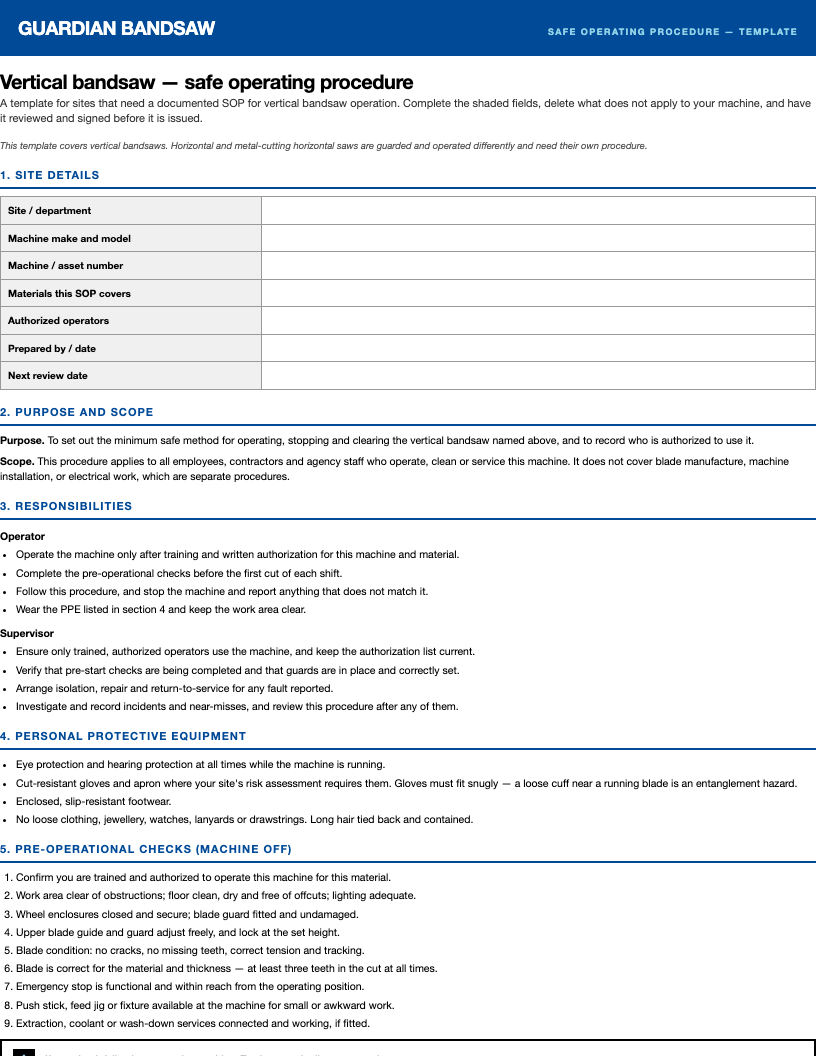
What the template covers
Eleven sections, in the order an SOP is normally read and audited. The whole text is below so you can see exactly what you are downloading; the DOCX is there so you can change it.
This template covers vertical bandsaws. Horizontal and metal-cutting horizontal saws are guarded and operated differently and need their own procedure.
1. Site details
Fields for the site to complete before the procedure is issued: site or department, machine make and model, machine or asset number, the materials the SOP covers, the authorized operators, who prepared it and when, and the next review date.
2. Purpose and scope
Purpose. To set out the minimum safe method for operating, stopping and clearing the vertical bandsaw named in section 1, and to record who is authorized to use it.
Scope. Applies to all employees, contractors and agency staff who operate, clean or service the machine. It does not cover blade manufacture, machine installation, or electrical work, which are separate procedures.
3. Responsibilities
Operator
- Operate the machine only after training and written authorization for this machine and material.
- Complete the pre-operational checks before the first cut of each shift.
- Follow the procedure, and stop the machine and report anything that does not match it.
- Wear the PPE listed and keep the work area clear.
Supervisor
- Ensure only trained, authorized operators use the machine, and keep the authorization list current.
- Verify that pre-start checks are being completed and that guards are in place and correctly set.
- Arrange isolation, repair and return-to-service for any fault reported.
- Investigate and record incidents and near-misses, and review the procedure after any of them.
4. Personal protective equipment
- Eye protection and hearing protection at all times while the machine is running.
- Cut-resistant gloves and apron where your site's risk assessment requires them. Gloves must fit snugly — a loose cuff near a running blade is an entanglement hazard.
- Enclosed, slip-resistant footwear.
- No loose clothing, jewellery, watches, lanyards or drawstrings. Long hair tied back and contained.
5. Pre-operational checks, machine off
- Confirm you are trained and authorized to operate this machine for this material.
- Work area clear of obstructions; floor clean, dry and free of offcuts; lighting adequate.
- Wheel enclosures closed and secure; blade guard fitted and undamaged.
- Upper blade guide and guard adjust freely, and lock at the set height.
- Blade condition: no cracks, no missing teeth, correct tension and tracking.
- Blade is correct for the material and thickness — at least three teeth in the cut at all times.
- Emergency stop is functional and within reach from the operating position.
- Push stick, feed jig or fixture available at the machine for small or awkward work.
- Extraction, coolant or wash-down services connected and working, if fitted.
If any check fails, the machine does not run. Tag it out and tell the supervisor.
6. Operating procedure
- Set the upper guide and guard so that only the working portion of the blade is exposed above the workpiece.
- Stand square to the machine at the operating position, out of the line of cut.
- Start the machine and let the blade reach full speed before the workpiece contacts it.
- Support the workpiece flat on the table. Use a jig or fixture for round, irregular or unstable pieces.
- Feed with steady, moderate pressure and let the blade do the work. Do not force the cut.
- Keep both hands out of the line of cut, offset to either side of the cutting line.
- Use a push stick or push block once your fingers would come within a hand's width of the blade.
- Do not reach over, behind or past the blade at any time.
- Stop the blade before backing out of a cut, clearing offcuts, or measuring the work.
- Never leave the machine running unattended. Stop it before you step away.
7. Shutdown and housekeeping
- Complete the cut, then switch off and wait for the blade to come to a complete stop. A coasting blade still cuts.
- Release blade tension if your machine manufacturer requires it between shifts.
- Clear offcuts and waste from the table and floor using a tool, not bare hands.
- Clean down as required for your material and, in food environments, to your sanitation schedule.
- Leave guards in place and the area clear for the next operator.
8. Jams, blade changes and cleaning
- Switch off and wait for the blade to stop completely.
- Isolate the machine and apply lockout/tagout. The key stays with the person doing the work.
- Clear the jam or change the blade using the correct tools. Never apply bare force.
- Refit and check the guard, blade tension and tracking before restoring power.
- Remove the lock and tag, then test-run before returning the machine to production.
9. Hazards
- Blade contact at the point of operation — laceration or amputation. The dominant cause is a hand slipping during a normal feed.
- Entanglement — gloves, sleeves, aprons, jewellery or hair drawn into the blade or wheels.
- Contact with a coasting blade when clearing or measuring too soon after switch-off.
- Blade breakage from incorrect tension, a dull blade, or forcing a curve too tight for the blade width.
- Stored energy released during blade changes and servicing.
- Slips and trips from offcuts, fat, coolant or water around the machine.
- Noise and airborne particulate depending on material.
10. Emergency actions and reporting
- Hit the emergency stop. Do not attempt to free a trapped person while the blade can move.
- Isolate the machine and apply lockout before any rescue or first aid at the machine.
- Summon first aid and emergency services. Preserve any amputated part per your first-aid procedure.
- Do not disturb the scene beyond what is needed to make it safe.
- Notify the supervisor immediately, and report to the regulator within the required time. In the United States that is within 8 hours for a fatality and 24 hours for an amputation, loss of an eye or in-patient hospitalization.
- Record the event, and report near-misses and dull or damaged blades through the same route.
11. Authorization and sign-off
A table for prepared by, reviewed by, date issued, and operator and supervisor signatures. Add a row per authorized operator, or attach your training matrix.
Formats, and what it costs
Nothing. The template is ungated — no email address, no signup, no form.
- Download the editable Word template (DOCX) — the one to use if you are writing your own procedure
- Download the print version, US Letter (PDF)
- Download the print version, A4 (PDF)
Licence. Free to use, print and share, including outside your organization. If you publish or link to it, please credit Guardian Bandsaw (guardianbandsaw.com). Please don't resell it or remove the attribution.
What this template is based on
The procedure is built from the standards that govern bandsaw guarding and servicing — OSHA 29 CFR 1910.212 (general machine guarding), 1910.213(i) (woodworking bandsaws) and 1910.147 (control of hazardous energy) — together with Guardian's own analysis of 919 severe bandsaw injuries in OSHA's severe injury reports for 2015 to 2025. The injury record is what determines the emphasis: the operating section spends most of its words on hand position and the point of operation, because that is where the injuries happen.
Requirements vary by jurisdiction, industry and machine. Read it against the standards that apply to you, and against your machine's manual, before you issue it.
Last reviewed: 7 September 2026.
Frequently asked questions
What is a bandsaw SOP?
A safe operating procedure is a written, site-specific document that sets out who may use a machine, what to check before starting, how to operate and shut it down, what to do when something goes wrong, and who signed it off. It is the document an auditor asks for, and the one new operators are trained against.
Is this SOP template free to use?
Yes. No form and no email address, and you may use and adapt it inside or outside your organization. We ask only that you credit Guardian Bandsaw if you publish or link to it.
Can I edit it and put our own branding on it?
Yes — that is what the DOCX is for. Fill in the site fields, delete what does not apply to your machine, add your own steps, and take it through your own approval process. A procedure that carries your site's rules should carry your site's sign-off.
Does this cover horizontal bandsaws?
No. It is written for vertical bandsaws. Horizontal metal-cutting saws are guarded under different provisions and operated differently, so they need a separate procedure.
Does having an SOP make us compliant?
No. A written procedure is one part of it. Compliance also depends on guarding, training and supervision, lockout/tagout, recordkeeping and the standards that apply where you operate. See our guide to OSHA bandsaw regulations for what an inspector actually looks at.
Use it with
The SOP is the document. The other two are what sits at the machine: the bandsaw safety checklist for the pre-start routine, and the bandsaw safety poster for the wall. The reasoning behind each rule is in the ten bandsaw safety rules.
Disclaimer. Guardian provides this document free of charge as general information for trained industrial operators and those who supervise them. It is not training, and it is not legal, engineering, or safety-compliance advice. It does not replace, and must not be used in place of: competent operator training and supervision; the machine manufacturer's operating manual and safety instructions; your organization's own risk assessment, safe working procedures, and site rules; or the safety legislation and standards that apply in your jurisdiction. No document can prevent an accident. Guardian makes no warranty that using this document will achieve compliance with any standard or prevent injury, and accepts no liability for loss, injury, or damage arising from its use. Confirm the content is appropriate to your machine, material, and operation before use. Last reviewed: 7 September 2026.