
A bandsaw is one of the machines an OSHA inspector is most likely to look at closely, and a reportable injury on one is very likely to bring that inspector to your door. This guide covers what the standards actually require of the machine and the employer, what you must do when an injury happens, what an inspection focuses on, and what non-compliance costs.
This is the compliance side. For the operating rules themselves — hand placement, blade selection, the lockout sequence — see our guide to the bandsaw safety rules.
What OSHA requires on a bandsaw
1910.212 — general machine guarding
29 CFR 1910.212 is the general machine-guarding standard, and it is the one that applies to most bandsaws outside woodworking — meat and poultry processing, metal fabrication, foundry cleaning rooms. It requires one or more methods of guarding to protect operators from hazards such as the point of operation, ingoing nip points and rotating parts, and it requires that the guard prevent the operator from having any part of the body in the danger zone during the operating cycle.
1910.213(i) — woodworking bandsaws
For woodworking machinery, 1910.213(i) is more prescriptive: the wheels must be fully encased, and all portions of the blade must be enclosed or guarded except the working portion between the bottom of the guide rolls and the table. In practice that means the adjustable upper guide and guard is set close to the workpiece so only the cutting section is exposed.
That exception is the whole subject. The standard accepts that the cutting zone cannot be enclosed, which is why guarding alone does not close the risk — the detail is in our guide to bandsaw guarding requirements.
Horizontal bandsaws: which standard applies
A point of confusion worth settling, because the guarding duty is written differently. 1910.213 is scoped to woodworking machinery, so a horizontal metal-cutting bandsaw is generally guarded under the general requirements of 1910.212 rather than under 1910.213(i). The substance of the duty is the same — guard the point of operation and the moving parts — but there is no prescriptive “enclose everything except between the guide rolls and the table” language to follow. Employers rely instead on 1910.212(a)(1) and (a)(3)(ii), the manufacturer's guarding and instructions, and where neither reaches, the general duty clause. If your site runs both vertical and horizontal machines, do not assume one guarding checklist covers both.
1910.147 — control of hazardous energy
29 CFR 1910.147, the lockout/tagout standard, governs servicing and maintenance. A bandsaw has moving parts, an electrical supply and stored energy in a tensioned blade, so clearing a jam, changing a blade or cleaning down all fall within it: shut off power, release stored energy, and lock or tag the isolation point before anyone reaches into the machine. Inspectors treat this as a paperwork question as well as a practical one — you need a written energy-control procedure for the machine, trained authorized employees, and a periodic inspection of the procedure.
ANSI Z244
It is also worth considering ANSI Z244, which covers the same ground and sets out best practice for alternative methods of controlling hazardous energy during servicing.
The National Emphasis Program on amputations
Because of the severity of workplace amputations, OSHA runs a National Emphasis Program directed at them. It was reissued in late 2019 and covers manufacturing establishments, allowing an entire master list of sites to be inspected in any order, and allowing NEP inspections to be combined with other programmed and unprogrammed inspections. If you run bandsaws in manufacturing, you are inside its scope. Read the NEP directive.
Recordkeeping
Employers must keep accurate, current records covering operator training on safe bandsaw operation, maintenance and inspection, incident reports for any bandsaw-related injury, and the corrective actions taken afterwards. These records are the evidence of your safety program during an inspection or an internal audit, and they let you see trends before an inspector does. Keep them organized, accessible, and retained for the required period.
How to report a bandsaw injury to OSHA
Reporting deadlines under 29 CFR 1904.39 are short and they are not the same for every outcome: a work-related fatality must be reported within 8 hours, and an amputation, loss of an eye or in-patient hospitalization within 24 hours of learning of it. Failing to report on time is itself citable.
Employers must report the incident by:
- In person or by phone to the OSHA office closest to the location of the incident
- By phone to the OSHA toll-free line
- Or by submitting the report form on the OSHA website
Required information includes:
- The business name
- The location of the work-related incident
- The time of the work-related incident
- Whether the incident involved a fatality, an in-patient hospitalization, an amputation, or an eye loss
- The number of employees who suffered this type of injury
- The name(s) of the employee(s) who suffered the injury
- The name and phone number of a contact at the establishment
- A brief description of the incident
What happens after you report
An OSHA area director decides how the incident is handled, broadly by severity.
Category 1 is the most serious and normally means an on-site inspection, which can lead to citations. Incidents are generally treated this way where they involve someone under 18, a fatality, two or more hospitalizations, a repeat offender, or an employer with similar incidents in the past 12 months.
Category 2 leaves the area director to decide between a site visit and a Rapid Response Investigation, in which the employer investigates and makes the changes needed to prevent a recurrence, usually after a phone call to gather the facts.
Category 3 is handled by the employer's own Rapid Response Investigation without a site visit.
What an inspector looks at on a bandsaw
If an inspection does happen, the machine itself is only the start. Expect attention on:
- Guarding as found. Wheel enclosures closed, the upper guide and guard adjusted down to the workpiece, and nothing removed, propped or bypassed. A guard that is present but parked at the top of its travel is a finding.
- The point of operation. What controls exist beyond the guard — push sticks, jigs, fixtures, hold-downs — and whether they are actually at the machine rather than in a drawer.
- Lockout/tagout. A written energy-control procedure specific to that machine, locks and tags in use, training records for authorized employees, and the periodic inspection of the procedure.
- Training records. Who is authorized to run this machine, when they were trained, on what, and who signed it off.
- The OSHA 300 log against the incident being investigated, and whether earlier similar events were recorded.
- Emergency stop function and whether it is within reach of the operating position.
- Housekeeping around the machine — offcut build-up, floor condition, lighting.
- Everything else in view. An amputation inspection rarely stays on the one machine that caused it.
What non-compliance costs
OSHA penalty maximums are adjusted annually for inflation. There is no adjustment for 2026, so 2025 levels carry forward. As of the 2026 figures:
- Serious — $16,550 per violation
- Willful — not less than $11,823 and not more than $165,514 per violation
- Repeated — up to $165,514 per violation
- Failure to correct — $16,550 per day beyond the abatement date
The citation is rarely the whole cost. An inspection takes production time, exposes other equipment to further citations while the inspector is on site, and sits alongside workers' compensation, the effect on your experience modifier, recruitment and retraining, and the effect on the people who watched it happen.
The CDC's NIOSH Safety Pays calculator, although built for a different industry, is a reasonable way to model the total cost of an injury to a business.
Compliance is the floor, not the ceiling
Guardian's analysis of OSHA severe injury reports from 2015 to 2025 identified 919 severe bandsaw injuries. Fewer than one narrative in a hundred mentions a missing guard. The injuries happen at the point of operation — the zone the standard expressly permits to be open — during ordinary cuts on compliant machines. See the full analysis.
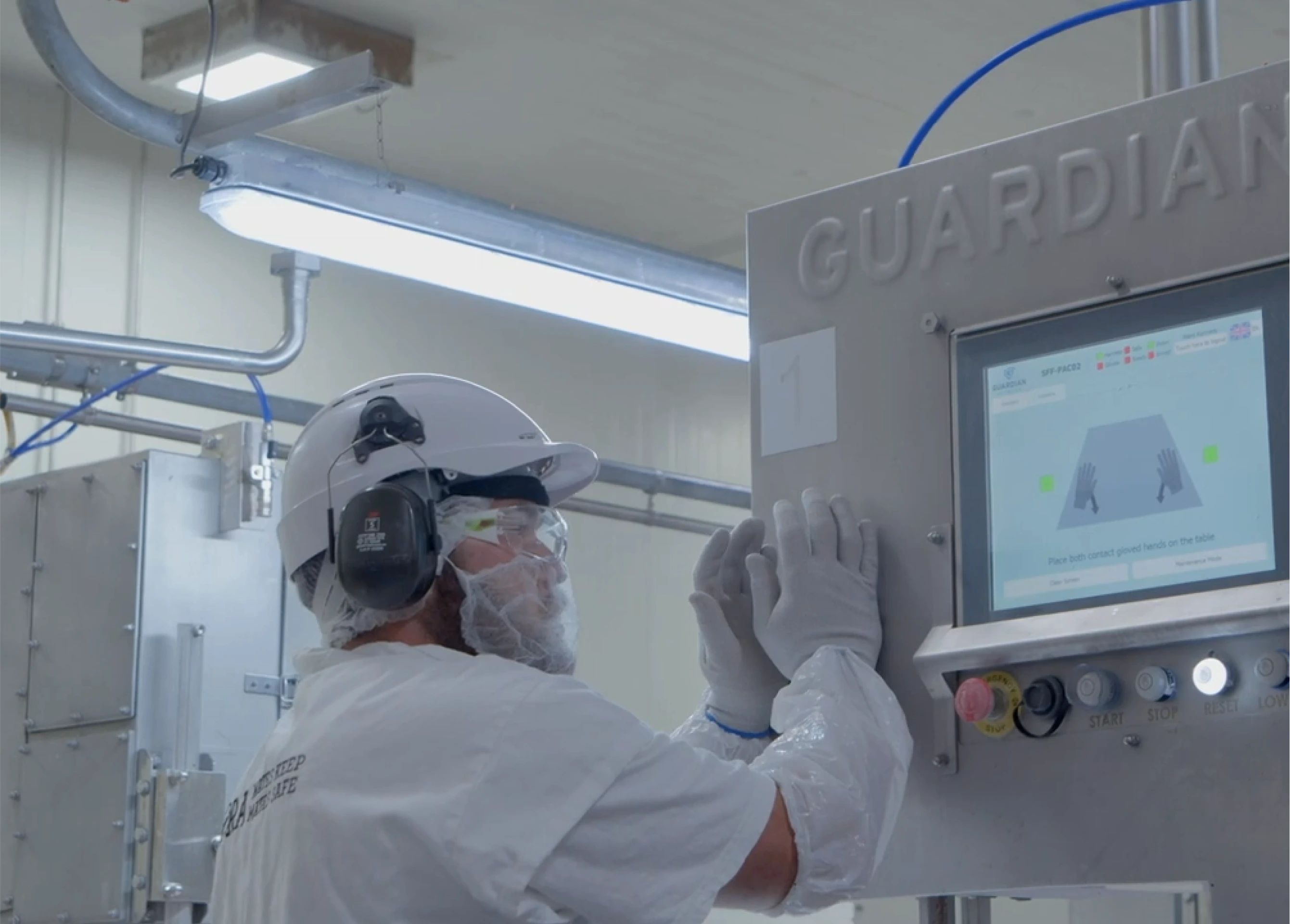
That is the residual risk a compliant guard cannot reach, and it is what active protection exists for. Guardian safety bandsaws watch a three-dimensional zone around the blade with four cameras and stop the blade in about 12 milliseconds when a gloved hand crosses into it, with a reset that takes seconds. Guarding and training remain required; the vision system covers the moment both are in place and a hand still slips.